current:
Die sozialistische Ecke (The socialist corner, 2023) is now part of the collection of the Kunstmuseen Krefeld. Since July 2026, the work is on view in the collection presentation Collection in Motion, 15 stories at the Kaiser Wilhelm Museum. The corner is not just for looking: you are invited to sit down and read the diaries of the two characters.
„logging bad deeds” has only ever existed in German. In the second half of 2026 the volumes published so far will be translated into English and produced as new hand-bound editions.
artist statement in accessible language:
I create installations that look like familiar social spaces: a bar, a living room, an exhibition display. Objects, figures, and light are arranged so that each scene feels real — yet nothing in it ever fully happens. In The Bar, a working bar stands at the center of the room, complete with counter, glasses, lighting, and seating. Mannequins in tailored outfits take the place of people, gathered around tables as if in conversation or waiting. Sometimes a real bartender serves drinks. Still, the exchange you expect never quite takes place. The promise of interaction stays suspended.
I work with textiles, clothing, furniture, printed matter, and found objects. All of the garments and costumes in my installations are custom-made: I design and sew them myself. Alongside the large installations, I make an ongoing series called Day Residues: works in fabric, thread, and paint that record everyday moments, almost like a diary. They often act as small, intimate echoes of the larger rooms. Diaries run through all of my work: inside the installations, fragments of stories appear as texts, diary pages, and objects. They never add up to one single story — personal and invented elements stay open.
Many of my objects point to a specific time and place — the Soviet era, Germany around 1900, or an imagined feminist future. My own biography is woven in as well: I came to Germany as a Jewish-Tatar refugee from the former USSR, and personal memories mix with historical and invented stories. Light shapes how all of this is seen. Studio lamps and color filters create zones of brightness and shadow. In this artificial atmosphere, things we usually keep out of everyday life become noticeable: the quiet desire to watch others, and the mixed needs we bring into shared spaces.
Each installation responds to the space it is shown in; elements are rearranged, added, or removed with every presentation. Visitors step into situations that seem familiar but feel slightly off — until they notice that they themselves are part of the staging, and on display too.
about my art in easy words
My name is Liora Epstein.
I am an artist.
I build art rooms.
The special word for this is: installation.
My installations look like places you know.
For example: a bar.
Or a living room.
Or an exhibition room.
One of my works is called: The Bar.
A real bar stands in a room.
There is a counter, glasses, lamps and chairs.
Mannequins stand at the tables.
Mannequins are dolls from shop windows.
The mannequins wear special clothes.
They stand there like real people.
Sometimes a real bartender works in the bar.
But there is no real conversation.
Everything looks real.
But nothing really happens.
I work with fabric and clothes.
I sew all of the clothes myself.
Each costume is made to fit exactly one figure.
I also work with furniture and found objects.
I also make small artworks from fabric.
This series is called: Day Residues.
They show moments from my everyday life.
A little bit like a diary.
In my installations there are also texts and diaries.
Visitors can read them.
The texts tell small stories.
Some stories are real.
Some stories are made up.
My art also tells about certain times.
For example: the Soviet Union.
Or Germany more than 100 years ago.
Or a future that I imagine.
My own story is important too.
I am Jewish and Tatar.
I fled from the Soviet Union to Germany.
My art tells about this.
Light is very important in my art.
Lamps and color filters make bright and dark areas.
The room feels real and strange at the same time.
Visitors can walk into my installations.
The rooms look familiar.
But something feels different.
People look at everything closely.
Then they notice:
Other people are looking at me too.
I am part of the exhibition myself.
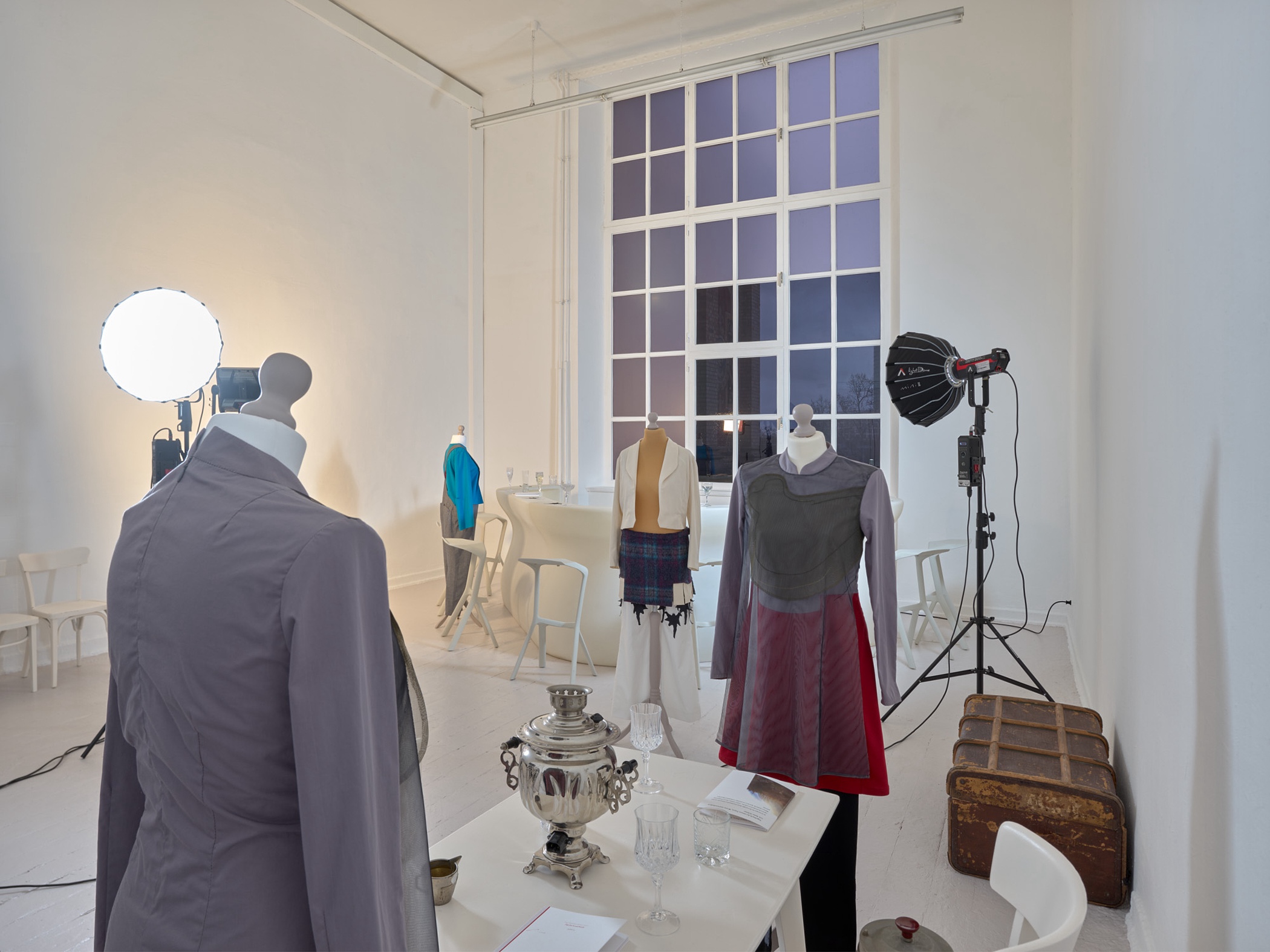
Installation view dispersed non-existence, 2023
Photos by Ivo Faber
© VG Bild-Kunst, Bonn