dispersed non-existence (2023)
Academic final project, Kunstakademie Düsseldorf
Loggings (logging bad deeds): Felix Adam, Liora Epstein, Susanne Schoenberg, Malin Speicher
Materials:
Textiles, studio lighting, bar with furnishings, domestic furniture, printed matter, mannequins, window film, laser-cut fabric elements, book editions, found objects
Dimensions:
Dimensions variable
Realized with the kind support of Party Rent Group and the Düsseldorfer Schauspielhaus
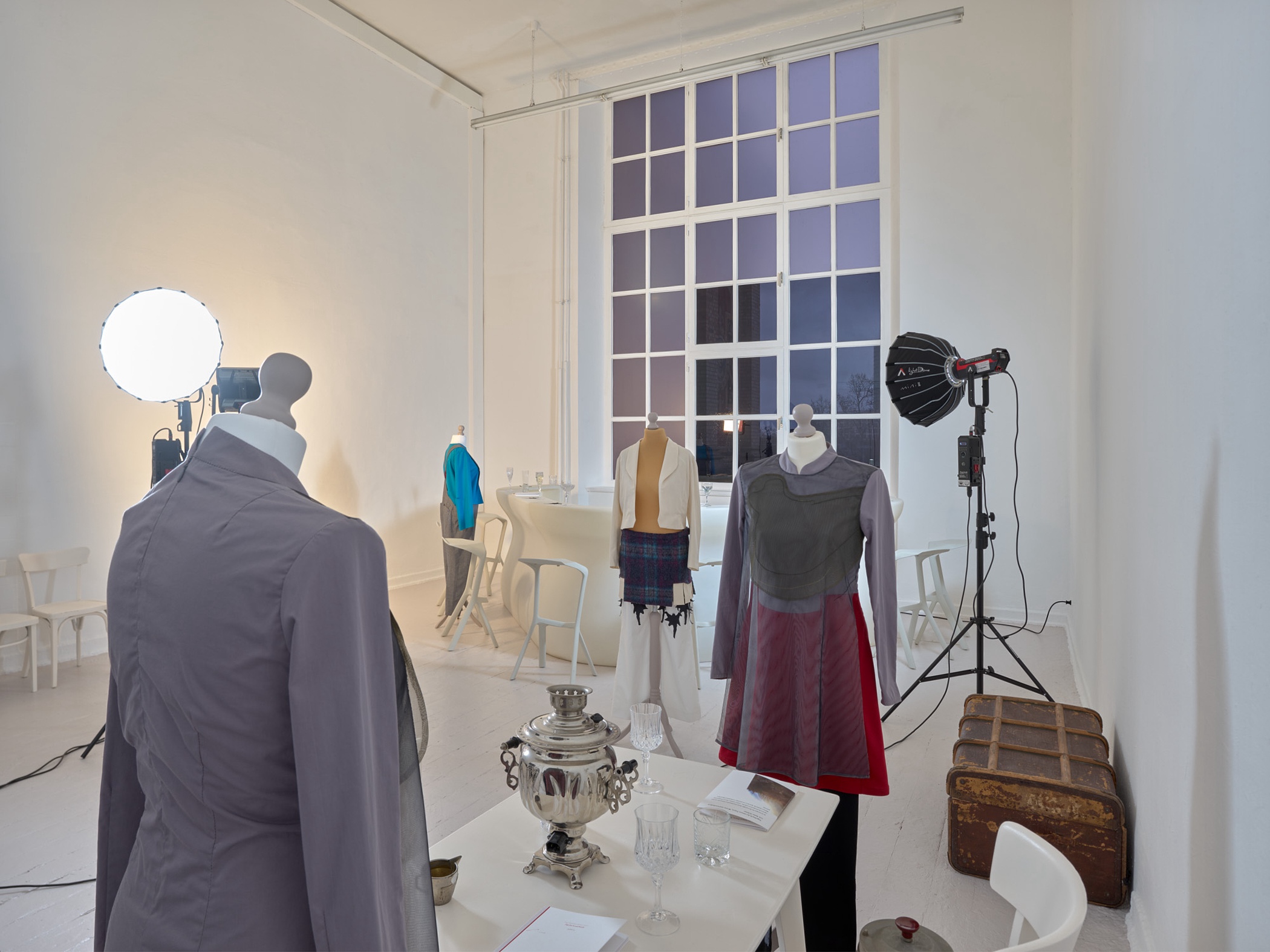
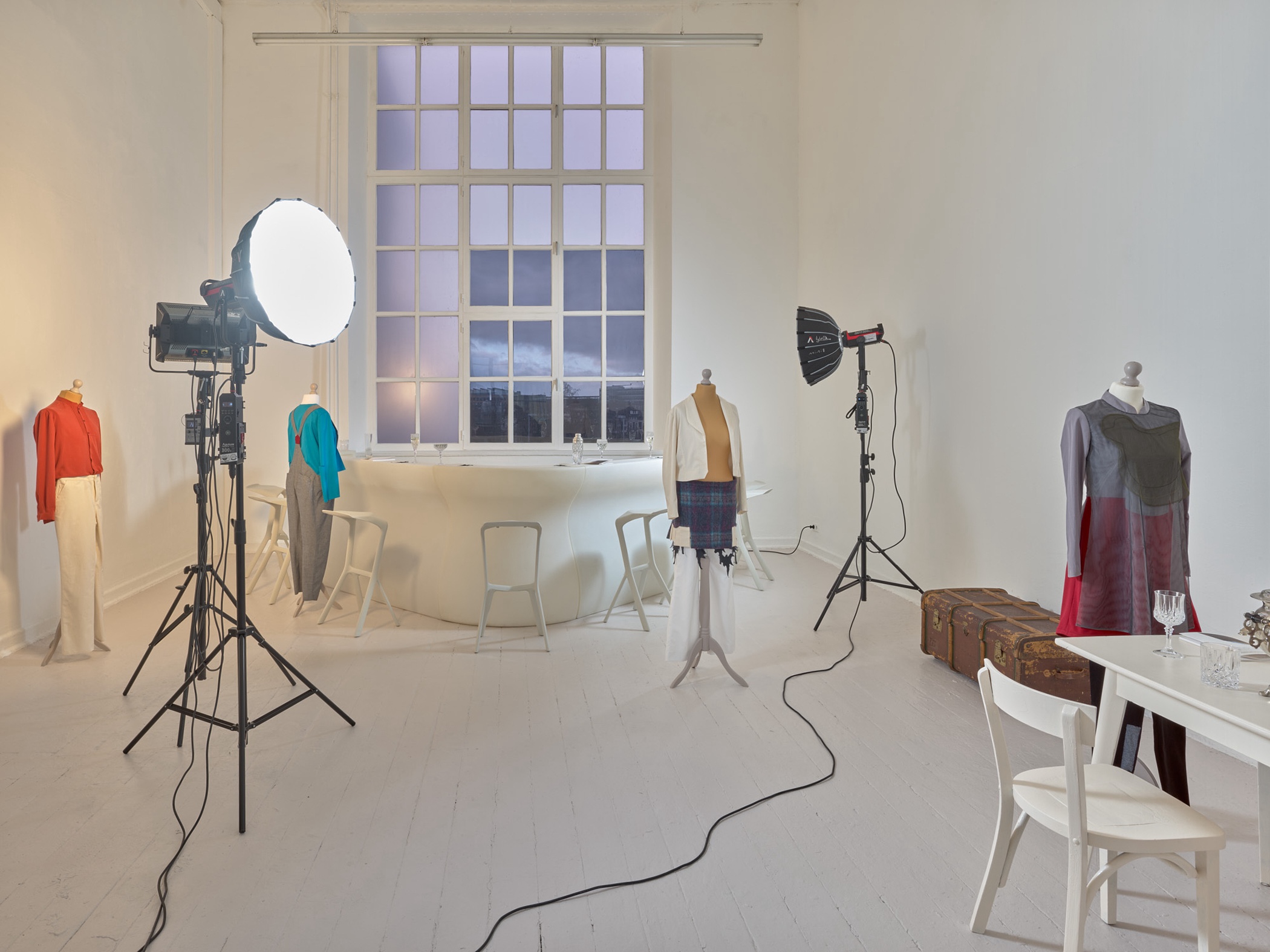
dispersed non-existence, Liora Epstein’s final project at the Kunstakademie Düsseldorf, unfolds as a staged environment in which temporal registers collapse. Visitors entering the space encounter a constellation of objects, figures, and light that refuses linear narration. Past, present, and future appear not as distinct categories but as overlapping conditions within a single spatial arrangement.
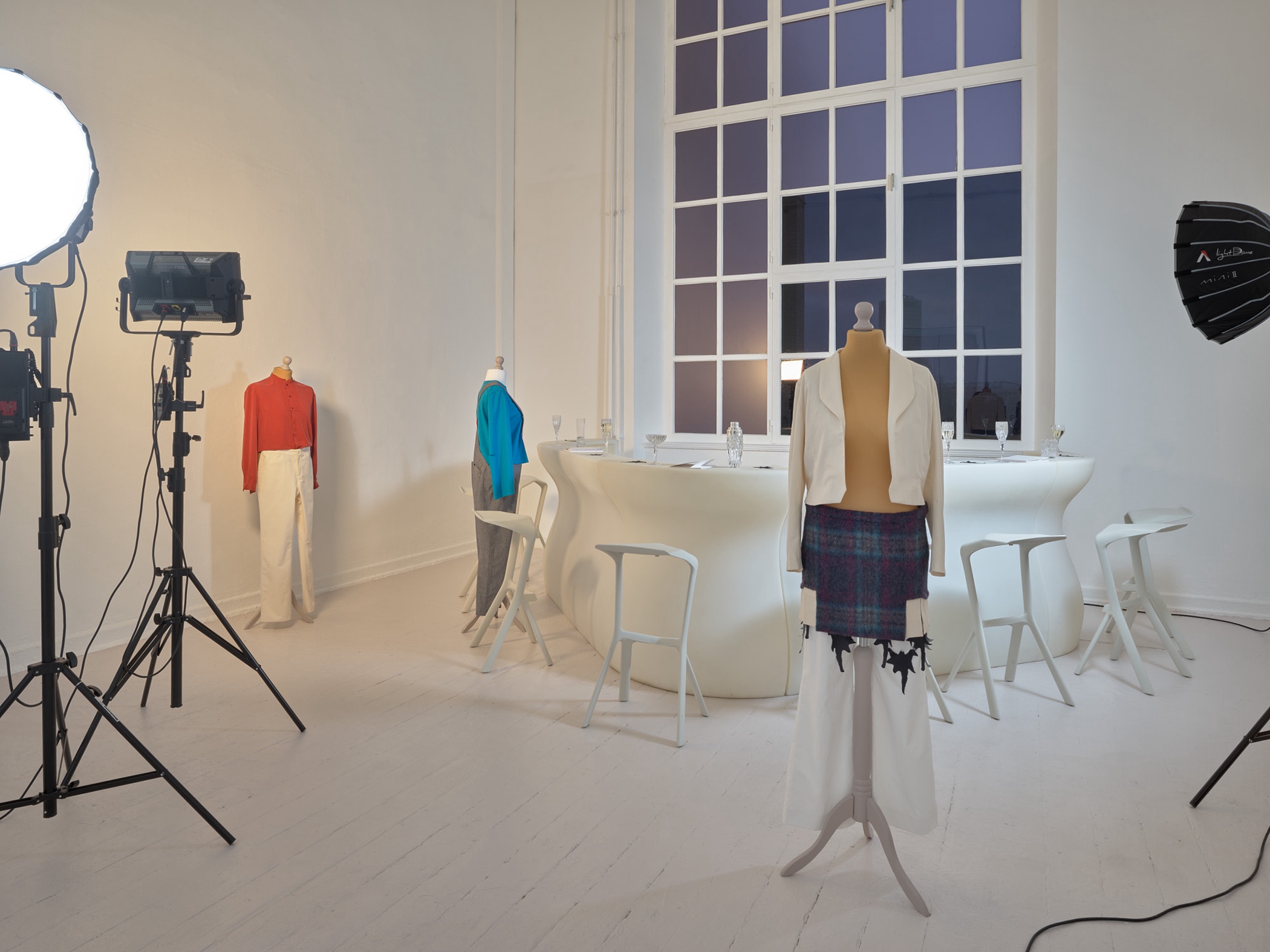
At the center of the installation stands a functional bar titled die sogenannte Gegenwart (the so-called present). Around it, five clothed mannequins mark figures from different temporal and ideological contexts. Four of them correspond to the four people who write logging bad deeds — Felix Adam, Liora Epstein, Susanne Schoenberg, and Malin Speicher — while a fifth figure stands outside that group. Epstein designs the costumes and garments in her installations, drafts the patterns, and sews them herself.
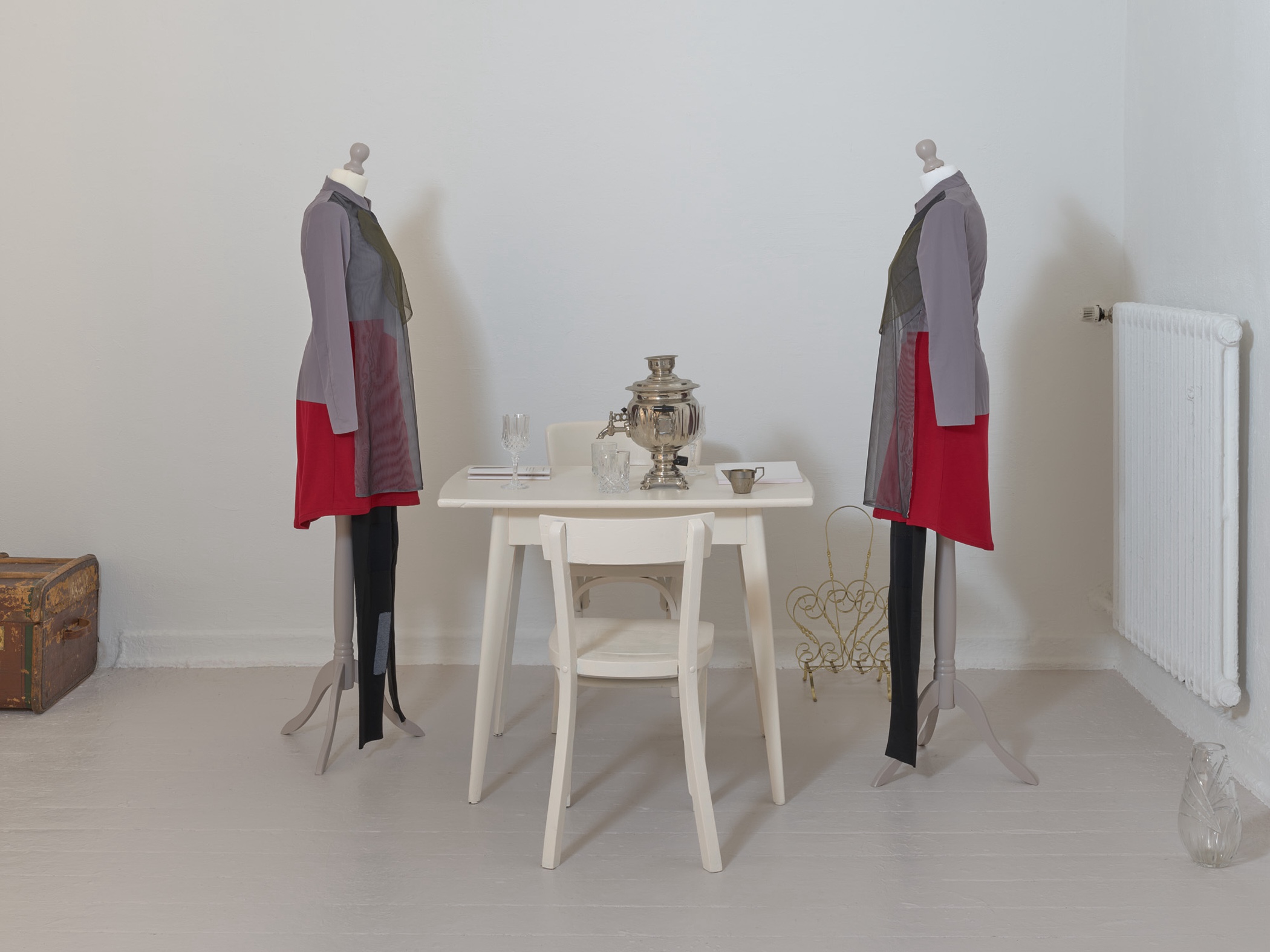
The entries of logging bad deeds are distributed across the bar and a secondary seating area, Die sozialistische Ecke (The socialist corner). The hand-bound books that hold them are called loggings. Rather than offering coherent biographies, they assemble fragments of worldview, contradiction, and self-description.
Coloured studio lighting and tinted window films produce an artificial atmosphere that modulates perception. Zones of heightened clarity alternate with areas of visual opacity, lending the space a suspended, dreamlike quality. The lighting operates less as illumination than as a structuring device, shaping attention and spatial orientation.
A bartender periodically activates the bar, serving drinks. While the gesture suggests hospitality and pause, it functions primarily as part of the installation’s scenography. Consumption, reading, and observation occur simultaneously, yet without resolving into genuine social exchange. The polished surface of the setting contrasts with the content of the loggings, which subtly destabilize the notion of a stable present and expose its constructed, ambivalent nature.
The bar later became an independent work, The Bar, shown at the Kunstmuseen Krefeld in 2024.
in easy words
dispersed non-existence is an artwork.
It was my final project at the art academy.
The academy is: Kunstakademie Düsseldorf.
The artwork is a big installation.
An installation is an art room you can walk into.
The artwork plays with time.
In this room, past, present and future exist at the same time.
Visitors see objects, figures and light.
Nothing tells one story from beginning to end.
Everyone finds their own way through the room.
In the middle of the room stands a real bar.
The bar has a name: die sogenannte Gegenwart.
That is German and means: the so-called present.
5 figures stand in the room.
They are mannequins with special clothes.
Mannequins are dolls from shop windows.
The figures come from different times.
And they have different ways of thinking.
I make all the costumes myself.
I design the clothes.
I also make the patterns for sewing.
Then I sew the clothes.
Next to the figures lie books.
The books come from the artwork logging bad deeds.
logging bad deeds means: writing down bad actions.
4 people write down these bad actions.
The 4 people are:
Felix Adam
Liora Epstein
Susanne Schoenberg
Malin Speicher
Liora Epstein is me.
I am the artist.
We call these books: loggings.
4 of the 5 figures belong to these 4 people.
1 figure is not one of these 4 people.
Some loggings lie on the bar.
Some lie in a corner with seats.
This corner has a name: die sozialistische Ecke.
That is German and means: the socialist corner.
The loggings do not tell whole life stories.
They show only pieces:
Thoughts, opinions and contradictions.
The light in the room is special.
Coloured lamps and coloured films on the windows change the room.
Some places are very bright.
Some places are hard to see.
The room feels a little bit like a dream.
The light shows you where to look and where to go.
Sometimes a bartender works at the bar.
He serves drinks.
It looks like a normal evening at a bar.
But it is part of the artwork.
People drink, read and watch.
But a real meeting does not happen.
The bar looks perfect and shiny.
The loggings tell something different.
They show: The “present” is not simple and stable.
People build it – like a stage.
Later the bar became its own artwork.
It is called: The Bar.
It was shown in Krefeld in 2024.
This work was supported by:
Party Rent Group
Düsseldorfer Schauspielhaus
Image 1, 2, 4 Installation view dispersed non-existence, 2023
Image 3 Die sozialistische Ecke (The socialist corner), 2023
courtesy Kunstmuseen Krefeld (DE)
Photos by Ivo Faber
© VG Bild-Kunst, Bonn